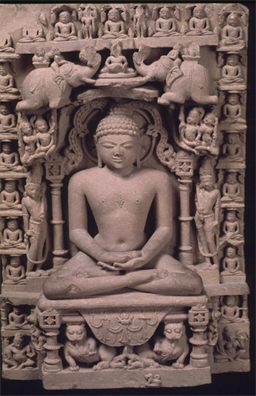
Mahavira
c. 599–527 BCE · Vaishali, Bihar, India
“Non-violence is the supreme religion. Every soul is independent.”
Mahavira, the 24th Tirthankara of Jainism, attained omniscience (Kevala Jnana) after 12.5 years of rigorous asceticism and taught for 30 years the path of total non-violence, non-attachment, and many-sided truth. His doctrine of Anekantavada — that reality is multi-faceted and no single perspective can capture the whole — remains one of the most sophisticated epistemological contributions in world philosophy.
Ask Mahavira
Biography
Vardhamana Mahavira (c. 599–527 BCE) was born into a ruling Kshatriya family in Vaishali, Bihar, into the ancient Sramana tradition of northeastern India. At 30, he renounced his family and possessions and undertook 12.5 years of extreme asceticism — moving through the countryside alone, enduring heat and cold, observing complete silence, practicing absolute non-violence even toward insects. At 42, meditating under a Sal tree on the banks of the Rijupalika river, he attained Kevala Jnana — omniscience, the complete and perfect knowledge of all things past, present, and future.
For the next 30 years, Mahavira traveled and taught across what is now Bihar and Uttar Pradesh, establishing an order of monks, nuns, and laypeople. He died at Pawapuri at age 72. His teachings, collected in the Agamas, form the scriptural foundation of Jain philosophy — one of the oldest living religious traditions on earth.
**Ahimsa — Non-violence**: The supreme ethical principle. Every living being — from the largest animal to the microscopic organisms in water and soil — possesses a soul (jiva). To harm any living being is to accrue karma. The monk's entire discipline — the careful walking, the filtering of water, the sweeping of the path — is organized around minimizing harm. For laypersons, ahimsa means vegetarianism, non-exploitation, and careful speech.
**Anekantavada — Many-Sidedness of Truth**: Perhaps Mahavira's most radical and original contribution. Reality is infinitely complex; any single statement captures only one perspective (naya). Therefore every assertion must be prefaced with "syat" — "in a certain respect," "from this angle." This prevents both dogmatism and nihilism. It has been called the world's first systematic epistemological relativism and is the philosophical foundation of Jain tolerance.
**Karma as Matter**: In Jainism, karma is not abstract moral bookkeeping but literally material — fine subtle particles that cling to the soul (jiva) through violent, attached, or untruthful actions, words, and thoughts. These karmic particles weigh down the soul, preventing it from rising to its natural state of luminosity and omniscience. Liberation = the progressive shedding of all karma.
**The Five Great Vows** (Mahavrata — for monks): Ahimsa (non-violence), Satya (truthfulness), Asteya (non-stealing), Brahmacharya (celibacy), Aparigraha (non-possession). For laypersons, these are taken in a lesser form (Anuvrata).
**Jiva and Moksha**: Every soul (jiva) is intrinsically omniscient, blissful, and powerful — it is only obscured by karma. When all karma is shed, the soul rises naturally to the top of the universe (Siddhashila) in a state of pure, eternal, self-luminous consciousness. This is not union with God (there is no creator God in Jainism) but the soul's own perfect nature shining through.
Mahavira taught that each soul is its own master and its own refuge — liberation cannot be given by a god or a guru but only achieved through one's own effort, discipline, and the progressive release from attachment.
Primary sources & resources
You may also wish to speak with
- Gautama Buddha — The middle path leads to cessation of suffering.
- Adi Shankaracharya — Brahman alone is real; the world is appearance.
- Sri Aurobindo — All life is yoga.
- Rupert Spira — Awareness is the knowing element in all experience. It is what you are.
- Dogen Zenji — To study the self is to forget the self.
- Patanjali — Yoga is the cessation of the fluctuations of the mind.