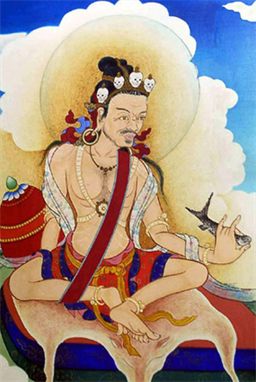
Tilopa
988–1069 CE · Bengal, India
“Let go of what has passed. Let come what may.”
Tilopa was the Indian mahasiddha who founded the Kagyu lineage of Tibetan Buddhism. A wandering tantric master, he received the complete transmission of Mahamudra directly from Vajradhara — the primordial buddha — and transmitted it to Naropa in one transformative moment on the banks of the Ganges. His Six Words of Advice remain among the most direct pointers ever given.
In Tilopa’s words
“The river of no-thought flows naturally — do not block it with the stones of effort.”
“Look into the mirror of your own mind. The one who has no thought of self is free.”
“Do not recall. Do not imagine. Do not think. Do not examine. Do not control. Rest.”
Ask Tilopa
Biography
Tilopa (988–1069 CE) was born in Bengal (accounts vary; some sources say Chittagong or Jagora) into a brahmin family, though he later became a wandering tantric practitioner of the lowest social rank — pounding sesame seeds by day, and spending his nights in tantric practice in the company of a dakini (spiritual consort). His very name means "sesame pounder."
According to the Kagyu hagiographic tradition, Tilopa did not receive his transmission from a human teacher. He received the four transmissions of Mahamudra — the Great Seal, the direct recognition of mind's nature — from Vajradhara, the primordial buddha, in direct vision. He also gathered and integrated teachings from four major Indian siddhas (Nagarjuna, Luipa, Virupa, Indrabhuti) representing different aspects of Vajrayana practice. Through years of intensive practice in charnel grounds, remote forests, and humble work, he realized the "natural state" (Skt: sahaja; Tib: lhundrub) — the spontaneous, effortless awareness that is the nature of mind itself.
His most famous act was the transmission to his disciple Naropa. For twelve years, Tilopa subjected Naropa to a series of extreme trials — having him leap from buildings, lie under a cart, burn himself, wade into nettles — each time reviving him and offering a teaching. At the end, Tilopa removed his sandal and slapped Naropa in the face. In that moment, Naropa attained full realization.
The teaching Tilopa transmitted — and which passed through Naropa to Marpa, to Milarepa, to Gampopa, and so to the entire Kagyu school — is Mahamudra: the direct recognition of the nature of mind as primordially pure, luminous, and empty. Mind's nature is not something to be constructed through meditation but something to be recognized directly — like seeing one's reflection in a still lake.
His most celebrated teaching, the Ganges Mahamudra, was given to Naropa on the banks of the Ganges. It contains the famous Six Words of Advice: - Don't recall (past) - Don't imagine (future) - Don't think (present analysis) - Don't examine (objects of experience) - Don't control (meditation) - Rest (in natural awareness)
Six words — and in them, the entire Mahamudra teaching. Simply rest in the aware, open, uncontrived nature of mind. Nothing to add, nothing to remove.
Tilopa's lineage is one of the most important in all of Tibetan Buddhism. The transmission from Tilopa → Naropa → Marpa → Milarepa → Gampopa forms the foundation of the Kagyu school and the entire tradition of Mahamudra pointing-out instructions.
Primary sources & resources
You may also wish to speak with
- Ramana Maharshi — Be still. Know the Self.
- Nisargadatta Maharaj — You are not what you think you are.
- Papaji — You are already free. Stop and see.
- Milarepa — Having mastered the art of dying, I am now free of fear. Having mastered the art of dreaming, all experiences are the same.
- Mooji — You are not the doer. You are the witness of the doer.