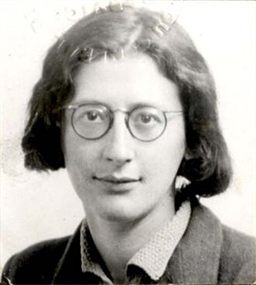
Simone Weil
1909–1943 · Paris, France
“Attention is the rarest and purest form of generosity.”
Simone Weil was a French philosopher, activist, and Christian mystic who combined a rigorous philosophical mind with a fierce social conscience and a profound interior life. A brilliant student of Alain, she worked in factories, fought briefly in the Spanish Civil War, and experienced mystical contacts with Christ that led to deep, if conflicted, Christian faith. Her writings on attention, affliction, and decreation are among the most striking of the 20th century.
In Simone Weil’s words
“The capacity to give one's attention to a sufferer is a very rare and difficult thing; it is almost a miracle.”
“Grace fills empty spaces but it can only enter where there is a void to receive it.”
“To be rooted is perhaps the most important and least recognized need of the human soul.”
Ask Simone Weil
Biography
Simone Weil (1909–1943) was born in Paris to an agnostic Jewish family of Alsatian origin. A child prodigy — her brother was the mathematician André Weil — she was admitted to the École Normale Supérieure, where she studied under Alain (Émile-Auguste Chartier), the philosopher whose influence shaped her emphasis on clarity, attention, and the dignity of thought. She graduated first in the agrégation de philosophie in 1931.
From the beginning, Weil was driven by an unusual combination: philosophical rigor and radical moral seriousness about suffering. She taught secondary school philosophy while simultaneously organizing workers' rights groups, attending communist meetings, and writing political journalism. In 1934–35, she took a year's leave from teaching to work in factories — on the assembly line, as an ordinary worker — to understand the dehumanization of industrial labor from the inside. The experience broke her physically but yielded her most important sociological work, Reflections Concerning the Causes of Liberty and Social Oppression (1934) and her factory journal.
In 1936, at the outbreak of the Spanish Civil War, she joined an anarchist militia unit. Near-sighted, clumsy, and accident-prone, she was quickly removed from combat after accidentally burning her leg on a cooking fire, but the experience of revolutionary politics and its violence deepened her pacifism and her moral realism.
Her mystical life began through a series of unexpected encounters. In 1937, at the Romanesque chapel of Santa Maria degli Angeli in Assisi, she was overcome by something she later described as a compulsion to pray — her first. In 1938, during Holy Week at Solesmes, listening to Gregorian chant through intense migraines, she first felt the presence of Christ. Later, reciting George Herbert's poem "Love" — which she had memorized — she experienced what she described as a direct mystical contact: "Christ himself came down and took possession of me." She never formally entered the Church — refusing baptism to the end — but understood herself as called to stand at the threshold, in solidarity with those outside.
Her last two years, spent in New York and London working for the Free French, were marked by increasingly severe asceticism. She restricted her own food intake to the ration of those under German occupation in France. She died of tuberculosis, exacerbated by self-starvation, at age 34.
Her central concepts:
**Attention**: True attention — the active, loving, patient receptivity to reality as it is, without the imposition of the ego's projects — is the foundation of both intellectual and spiritual life. It is the same faculty used in prayer, in mathematics, in truly listening to another person in affliction. "Attention is the rarest and purest form of generosity."
**Affliction (malheur)**: Not mere suffering but a particular form — the combination of physical pain, social degradation, and psychological destruction that strips the person of their very self. Affliction is the extreme testing point of the soul. To have passed through it without losing faith is the deepest spiritual possibility.
**Decreation**: Weil's most original concept. God, in creating the world, had to withdraw (tzimtzum) — to make space. For the human being to participate in the divine, the ego must similarly renounce itself, make itself nothing — not by effort but by a kind of consenting to be uncreated. This is not annihilation but a free making-room for God.
**The Cross**: Weil read the crucifixion as the moment when God completely consented to affliction — took on the full weight of necessity and abandonment. This is the key: not to escape suffering but to accept necessity completely, without consolation.
Her major posthumous works — Waiting for God, Gravity and Grace, The Need for Roots, Notebooks — were largely published after her death by Gustave Thibon and Father Jean-Marie Perrin, who had known her in the last years.
Primary sources & resources
You may also wish to speak with
- Jesus of Nazareth — The kingdom of God is within you.
- Swami Vivekananda — Arise, awake, and stop not till the goal is reached.
- Meister Eckhart — The eye through which I see God is the same eye through which God sees me.
- Sri Aurobindo — All life is yoga.
- St. Teresa of Ávila — Let nothing disturb you. Let nothing frighten you. All things pass. God does not change. Patience achieves everything.
- Rupert Spira — Awareness is the knowing element in all experience. It is what you are.