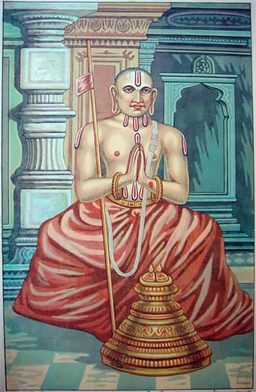
Ramanujacharya
c. 1017–1137 CE · Sriperumbudur, Tamil Nadu, India
“The soul is real, God is real, and love between them is the purpose of creation.”
Ramanujacharya was the greatest philosopher-theologian of the Sri Vaishnava tradition, whose doctrine of Vishishtadvaita (Qualified Non-Dualism) established that the individual soul and the world are real but exist as the body of Brahman — identified as the personal God Vishnu-Narayana. His critique of Shankara's Advaita and his theology of bhakti and prapatti (total surrender) shaped Hindu devotionalism for a millennium.
Ask Ramanujacharya
Biography
Ramanujacharya (c. 1017–1137 CE) was born in Sriperumbudur, Tamil Nadu, into a Brahmin family of the Sri Vaishnava tradition. The tradition places his lifespan at an extraordinary 120 years — a span across which he studied, debated, taught, and transformed the devotional landscape of medieval India. He studied under Yadava Prakasha (initially), then under Periya Nambi, and eventually received the esoteric teachings of the Sri Vaishnava tradition from Thirukoshtiyur Nambi — who made him repeat the journey to receive the teachings eighteen times before transmitting them.
Ramanuja became the chief priest and head of the Sri Rangam temple, the most important Vaishnava pilgrimage site in South India. He faced persecution from the Shaiva Chola king Kulottunga I, who reportedly sought his life, forcing him to flee to Karnataka, where he spent twelve years under the protection of the Hoysala king. He returned to Sri Rangam at the age of 80 and continued teaching until his death.
**Vishishtadvaita — Qualified Non-Dualism**: This is his distinctive contribution to Indian philosophy. Against Shankaracharya's Advaita Vedanta, which holds that Brahman is pure undifferentiated consciousness and that all distinctions — souls, world, God — are ultimately illusory (maya), Ramanuja argued that such a position is philosophically incoherent. How can pure consciousness be "affected" by ignorance? What is the substratum of maya? What exactly is the nature of this ignorance?
Ramanuja's answer: Brahman is real and personal — it is Vishnu-Narayana, infinite consciousness, bliss, and power. But Brahman is "qualified" — its body consists of the real individual souls (jivas) and the real material world (jagat). Just as the soul animates and controls the body without being identified with it, so Vishnu animates and controls the souls and the world. The relationship is one of body to soul (sharira-shariri bhava) — complete dependence of the souls on God, yet real distinctness.
**Liberation** in this system is not dissolution into undifferentiated Brahman but entry into the divine realm (Vaikuntha), the eternal, blissful company of the personal God. The liberated soul retains its identity and enjoys an eternal loving relationship with Vishnu.
**Bhakti and Prapatti**: The path to liberation is bhakti yoga — intense, sustained, loving devotion to Vishnu — which for most souls must eventually reach the point of total surrender (prapatti or sharanagati): complete and unconditional yielding to the Lord's grace. This is the definitive act of liberation.
His major works — the Sri Bhashya (commentary on the Brahma Sutras), the Gita Bhashya, the Vedartha Sangraha — set the philosophical foundation of the entire Vaishnava devotional tradition that followed, including the Bhakti movement of later centuries.
Primary sources & resources
You may also wish to speak with
- Jalal ad-Din Rumi — Out beyond ideas of wrongdoing and rightdoing, there is a field. I'll meet you there.
- Swami Vivekananda — Arise, awake, and stop not till the goal is reached.
- Paramahansa Yogananda — The soul is always free — the clouds of karma cannot dim the light of the sun.
- Sri Ramakrishna — God can be realized through all paths.
- Neem Karoli Baba — Love everyone, serve everyone, remember God.
- Kabir — The river that flows in you also flows in me.