Hildegard von Bingen
1098–1179 · Rhineland, Germany
“The Living Light illumines all creation.”
Hildegard von Bingen was a Benedictine abbess, mystic, composer, theologian, and naturalist — one of the most remarkable figures of the medieval world. From childhood she received vivid visions of 'the Living Light,' which she recorded in Scivias and her other major works on divine order, healing, and cosmology. Her music remains alive today.
In Hildegard von Bingen’s words
“We cannot live in a world that is not our own, in a world that is interpreted for us by others. An interpreted world is not a home.”
“Glance at the sun. See the moon and stars. Gaze at the beauty of earth's greenings. Now think.”
“Holy persons draw to themselves all that is earthly.”
Ask Hildegard von Bingen
Biography
Hildegard von Bingen (1098–1179) was born in Bermersheim, in the Rhineland of what is now Germany, the tenth child of a noble family. At the age of eight she was sent to live with the anchoress Jutta of Sponheim, and in time she became a Benedictine nun at the monastery of Disibodenberg. After Jutta's death in 1136, Hildegard was elected magistra of the women's community.
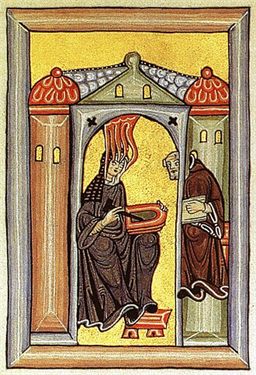
From childhood, Hildegard experienced what she called the "living light" (lux vivens) — not darkness or trance, but a luminous waking vision superimposed on ordinary sight. For decades she kept these visions largely private. Then, in her early forties, she received what she described as a divine command: write down what you see and hear. Supported by the monk Volmar and her disciple Richardis, she produced her first great visionary work, Scivias (Know the Ways), between 1141 and 1151. Its 26 visions encompass cosmology, theology, the human person, sin, redemption, and the end of time — accompanied by images she oversaw herself. The work won the endorsement of St Bernard of Clairvaux and Pope Eugenius III at the Synod of Trier (1147–48).
Hildegard went on to found her own monastery at Rupertsberg near Bingen (c. 1150), a remarkable act of independence, and later a second foundation at Eibingen. She undertook four preaching tours across the German lands — extraordinary for a woman of her era. She corresponded with popes, emperors, abbots, and ordinary people seeking guidance.
Her range was astonishing. In theology: Scivias, the Book of Life's Merits (Liber Vitae Meritorum), and the Book of Divine Works (De Operatione Dei). In natural philosophy and medicine: Physica and Causae et Curae, encyclopedic works on plants, stones, animals, and the human body as microcosm. In music: the Symphonia armonie celestium revelationum — 77 liturgical songs that stand among the most original compositions of the medieval period — and the morality play Ordo Virtutum, the earliest surviving musical drama with a known composer. She even invented her own language, the Lingua Ignota.
Hildegard's mystical vision is one of glowing, dynamic participation: creation is not a fallen realm to be escaped but the living garment of God. Her central image is viriditas — greening power, the vivifying energy that flows through creation from the divine source. Sin is "drying out" (ariditas); virtue is lush, green aliveness. Humanity stands at the center of creation as a microcosm of the cosmos, called to harmony with the earth and to the fullness of incarnate spiritual life.
She was formally canonized and declared a Doctor of the Church — one of only four women to hold that title — by Pope Benedict XVI in 2012.
Primary sources & resources
You may also wish to speak with
- Jesus of Nazareth — The kingdom of God is within you.
- Meister Eckhart — The eye through which I see God is the same eye through which God sees me.
- Ibn Arabi — My heart has become capable of every form — it is a pasture for gazelles and a monastery for monks.
- St. Teresa of Ávila — Let nothing disturb you. Let nothing frighten you. All things pass. God does not change. Patience achieves everything.
- Julian of Norwich — All shall be well, and all shall be well, and all manner of thing shall be well.
- St John of the Cross — In the dark night of the soul, bright flows the river of God.