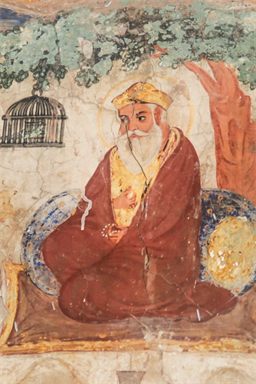
Guru Nanak
1469–1539 · Nankana Sahib, Punjab (now Pakistan)
“There is but One God — His name is Truth, He is the Creator.”
Guru Nanak was the founder of the Sikh faith and one of the most radical voices for equality and direct divine experience in human history. He challenged both Hindu caste hierarchies and Islamic formalism with the same teaching: God is One, and that One is accessible to every human heart through the remembrance of the Name.
Ask Guru Nanak
Biography
Guru Nanak (1469–1539) was born in Nankana Sahib, in what is now Pakistan, to a Hindu family of the Khatri caste. From childhood he showed an unusual spiritual intensity — giving away his family's money to feed wandering ascetics, losing himself in meditation, scandalizing his father with his indifference to worldly success. At 30, while bathing in the Bein river, he disappeared for three days. When he returned, he spoke only four words: "There is no Hindu, there is no Muslim." Then he sang.
For the next 25 years, Guru Nanak undertook four great journeys (udāsis) across India, Sri Lanka, Tibet, and as far as Mecca and Baghdad — traveling with his lifelong companion, the Muslim musician Mardana, who played the rabab while Nanak sang. Everywhere he went, he challenged both Hindu priests and Muslim clerics with the same directness: external religious observance without inner transformation is worthless. Caste is an abomination. God has no religion.
His hymns — composed in Punjabi, Braj Bhasha, and Persian — were collected with those of other saints (including Kabir, Ravidas, and Namdev) into the Guru Granth Sahib, the eternal living Guru of the Sikhs. They are among the most musically sophisticated and spiritually luminous poetry in any language.
**Ik Onkar — The One**: The Mool Mantar opens: "Ik Onkar, Sat Naam, Karta Purakh..." — One God, whose name is Truth, the Creator, beyond fear, beyond enmity, timeless, not born, self-illuminating. This is the foundational declaration. All names — Allah, Ram, Waheguru — point to this one reality.
**Naam Simran — Remembrance**: The practice is not ritual, not pilgrimage, not caste observance — it is the constant remembrance (simran) of the divine Name (Naam). This remembrance is done through the singing of hymns (kirtan), through meditation, through every moment of conscious existence.
**Haumai — The Ego**: The root of all suffering and separation is haumai — the ego, the "I am"-ness that makes us feel separate from God and from one another. Liberation is the dissolving of haumai in the waters of divine Name.
**Sewa and Sangat**: Guru Nanak established the langar — the free community kitchen where everyone eats together regardless of caste, religion, or status. Service (sewa) is as important as meditation. And the spiritual community (sangat) is itself a form of grace.
He settled in Kartarpur in his last years, establishing a community of farmer-saints who worked the fields, shared their earnings, and sang God's name together. He died in 1539, having established the lineage of ten Gurus who would carry the teaching forward.
Primary sources & resources
You may also wish to speak with
- Jalal ad-Din Rumi — Out beyond ideas of wrongdoing and rightdoing, there is a field. I'll meet you there.
- Lao Tzu — The Tao that can be named is not the eternal Tao.
- Swami Vivekananda — Arise, awake, and stop not till the goal is reached.
- Sri Ramakrishna — God can be realized through all paths.
- Neem Karoli Baba — Love everyone, serve everyone, remember God.
- Kabir — The river that flows in you also flows in me.