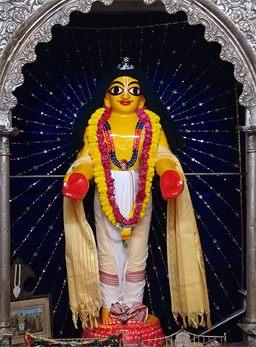
Chaitanya Mahaprabhu
1486–1534 · Nabadwip, Bengal, India
“Chant the holy name, dance in divine love — this is the highest yoga for this age.”
Chaitanya Mahaprabhu was a 15th-century Bengali saint whose ecstatic love for Krishna transformed the devotional landscape of India and ultimately the world. He founded the Gaudiya Vaishnava tradition, propagated the chanting of the Hare Krishna Maha-mantra as the supreme spiritual practice, and was regarded by his followers as Krishna himself appearing in the mood of Radha.
Ask Chaitanya Mahaprabhu
Biography
Sri Krishna Chaitanya Mahaprabhu (1486–1534), born Vishvambhara Mishra (affectionately called Nimai) in Nabadwip, Bengal, was a child prodigy of Sanskrit scholarship who underwent a complete spiritual transformation at age 22 during a pilgrimage to Gaya, where he encountered his guru Ishvara Puri. From that moment, the brilliant logician became an ecstatic devotee — weeping, singing, dancing, and losing himself in love for Krishna.
For the next 24 years, Chaitanya transformed Bengal and then all of India. He organized massive sankirtana processions — hundreds, sometimes thousands of people chanting the names of Krishna through the streets — and challenged the caste system by embracing untouchables, Muslims, and sinners with equal divine love. He sent six disciples — the Six Goswamis — to Vrindavan to systematize the theology of Gaudiya Vaishnavism. He himself spent the last 18 years of his life in Jagannath Puri in increasingly intense states of divine ecstasy, his body exhibiting extraordinary signs of spiritual transformation — hair standing on end, tears flowing constantly, limbs contracting and expanding in the bhava of Radha.
**Achintya Bhedabheda — Inconceivable Simultaneous Difference and Non-Difference**: Chaitanya's philosophical position, elaborated by his followers: The relationship between Krishna and the individual souls, between Krishna and his energies, is neither simple identity (as in Advaita) nor simple difference (as in Madhva's Dvaita) but something beyond the reach of logical categories — inconceivable (achintya) simultaneous identity and difference. The souls are simultaneously one with and different from Krishna, like waves that are simultaneously water and distinct formations.
**Radha-Krishna as Supreme Reality**: For Chaitanya, Krishna is the Supreme Personality of Godhead (Svayam Bhagavan), the original source of all divine manifestations. And the highest form of divine love — the love that most completely mirrors the divine ecstasy — is the love of Radha for Krishna: madhura rasa (the sweetness of conjugal love). This is not a metaphor for something else; it is the literal supreme spiritual reality.
**Nama Sankirtana**: The practice Chaitanya propagated as supremely suited to the Kali Yuga: the communal chanting of the divine names. The Maha-mantra: "Hare Krishna, Hare Krishna, Krishna Krishna, Hare Hare / Hare Rama, Hare Rama, Rama Rama, Hare Hare." In the Name, the Named is fully present.
**The Siksastaka — Eight Verses**: The only writings Chaitanya left are eight verses — the Siksastaka — which contain the essence of his teaching in condensed form: the glories of the holy name, the mood of the devotee (humbler than a blade of grass, more tolerant than a tree), and the aching, longing love of separation that is itself a form of the highest union.
His lineage was carried into the 20th century by Srila Bhaktivinoda Thakura and Srila Bhaktisiddhanta Saraswati, and then to the entire world by A.C. Bhaktivedanta Swami Prabhupada, who founded ISKCON in 1966.
Primary sources & resources
You may also wish to speak with
- Jalal ad-Din Rumi — Out beyond ideas of wrongdoing and rightdoing, there is a field. I'll meet you there.
- Lao Tzu — The Tao that can be named is not the eternal Tao.
- Sri Ramakrishna — God can be realized through all paths.
- Neem Karoli Baba — Love everyone, serve everyone, remember God.
- Kabir — The river that flows in you also flows in me.
- Hafiz — Even after all this time, the sun never says to the earth: 'You owe me.'